Visualizzazione post con etichetta Il trovatore. Mostra tutti i post

lunedì 20 aprile 2015

When "Il Trovatore" met contemporary music: Luciano Berio, Italo Calvino and "La vera storia" - Part 2 - Looking for the true story

Now that you know Luciano Berio and Italo Calvino, let's move on and talk about La Vera Storia. Let's start from basics: La Vera Storia is strictly related to Il Trovatore. In fact, the plot of the first act shows us both what in Il Trovatore is represented on scene (two men fight because they love the same woman) and what in Il Trovatore is not represented on scene but is only told by Azucena and Ferrando.

1. Act 1: the story of Ada and Ugo

So, let's see what happens during the first act. When the curtain opens, we are in a square in a town in Southern Italy. It's feast day and all the people are happy; there's a brass band playing and everything seems to be going well.


But suddenly something happens: the police arrives...


...they take a man...


...and they execute him, as you cannot see in the following image (sorry, the scene was too violent. But here below you can see some people having a nice party during the popular feast).


What happens right now? It is very easy: Ada, the executed man's daughter (to be fair, Calvino in the libretto write that she could be his daughter, giving to this a certain degree of uncertainty, while Berio writes in the score that she is the executed man's daughter, showing this relationship to be certain) abducts the son of Ugo, who is the Governor of the Town and who she thinks is responsible for her father's death. So, she takes Ugo's son away and takes him to the big tentacular city...
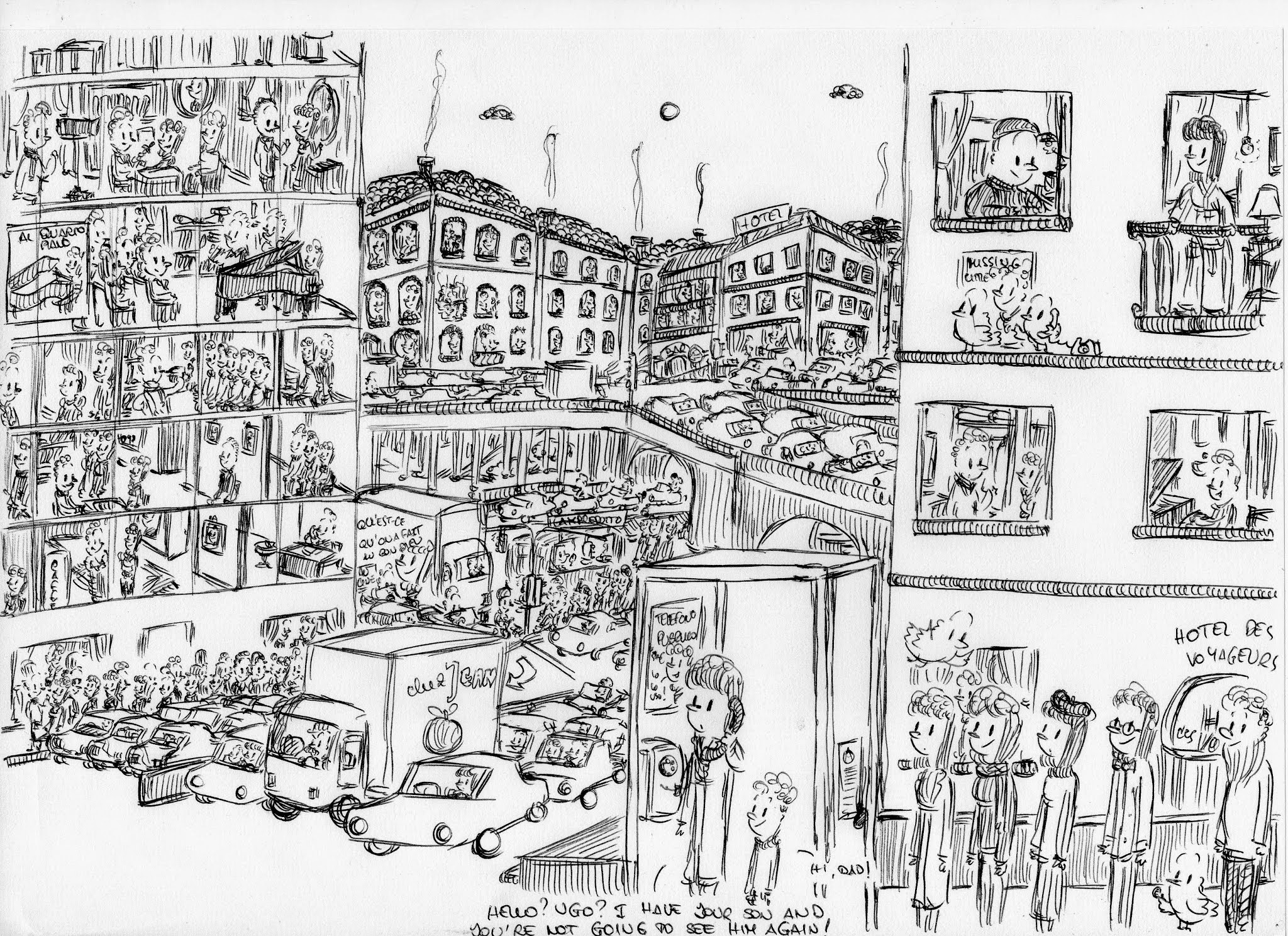


...where he'll become a broker without heart (ok, I made up the last point).


Now, after the abduction of Ugo's son, a cantastoria enters and sings a Ballad. It is the first of six Ballads the cantastoria will sing during the first act: the six ballads comment what's happening on scene and have a musical style which can be archaic, modern or popular. In the first representation of La Vera Storia, the cantastoria was interpreted by the famous Italian pop singer Milva and in the following video we can see her singing the first Ballad from La Vera Storia. In this Ballad, the cantastoria explains why Ada decided to abduct Ugo's son:


We've already said that Berio was very interested in popular traditions and that's why one of the characters in this opera is a cantastoria, who sometimes enters and sing a ballad to comment what happened on scene. Do you know what a cantastoria is? Cantastorie were, in Southern Italy (but we can find them also elsewhere, for instance in the Balkans), popular storytellers who went in towns and villages and there told stories and sang songs about various subjects: love, death, heroes of the Carolingian cycle (let's think for instance about Sicilian Opera dei Pupi) and about events which had recently happened in the region or in the country (for instance, there are many Cantastorie songs which speak about bandits in Southern Italy in the second half of 1800). So, they both entertained and informed about various subjects the audience who listened to them during the feasts.

Berio puts this form of popular storytelling in his opera and makes a pop singer play the cantastoria: this creates an opera in which two worlds coexist and interact. In fact, we have:

1) The world of the "characters" (Ada, Ugo, the condemned to death, the choir and the other characters we'll meet later): the characters act on scene and are the protagonists of what's happening. They are interpreted by "traditional" opera singers, even though Berio make those singers use their voices in lots of different and sometimes uncommon and not-so-traditional ways: he make them sing, he make them talk, he make them use sprechgesang and so on. Do you remember when we talked about Berio's interest for voice and ways of singing? Well, in La Vera Storia we can see an example of that.

2) The world of "narration", which is represented by the cantastoria (to be fair, there are two cantastorie): the cantastoria does not take part to what happen on scene, but comment, repete or tell in a poetic way what's going on. What's more, the cantastoria, as we've already said, is not interpreted by a traditional opera singer but by a pop singer.

But now let's move on...

After the abduction of his son, Ugo dies of sorrow...


...and his other son Ivo takes his place, promising to avenge him.
2. Act 1: the story of Ivo, Luca and Leonora

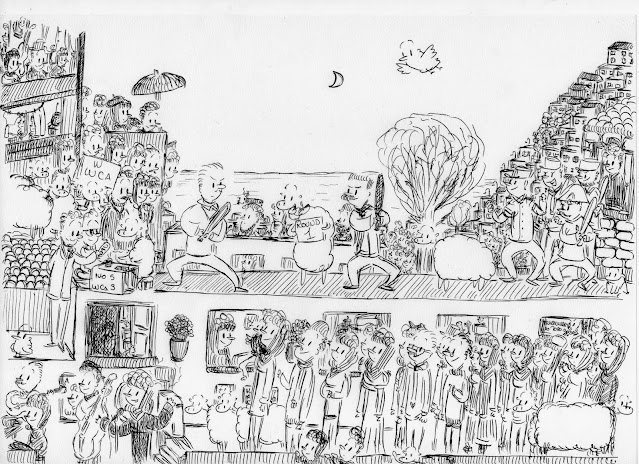
What follows is very simple: Ivo falls in love with Leonora, who is loved by Luca as well. The two men quickly begin to struggle for Leonora's love and Ivo is supported by the police, while Luca is supported by the people. Luca and Ivo fight a duel...


...and Ivo gets wounded and Luca is arrested and condemned to death.

Now Ivo is in hospital and Luca is in jail, while Little Ugo joined a populist movement and is candidate for MP in general elections (ok, I made the last point up).


3. "La Vera Storia" and "Il Trovatore": two operas on narration

Now that we've talked about Act I, we'll make what you all expect us to do...

...and we won't talk about Act II. Oh, you'll say, that's nonsense! Let us now what happen in act II, come on! Well, actually, that's the problem: in act II nothing happens. Act II is simply a re-elaboration of musical and textual materials which have already been used in Act I. In other words, in Act II we listen to the same music and words we've listened to in Act I, but put in a different order and with changes and cuts.

Act II is, as Berio said, a repetition or a parody of Act I and this is proved also by the fact that, if we go and read the libretto, we discover that there's no libretto for act two; instead, there is a table in which Berio writes in what scene of Act II we'll find the texts and the musical pieces we've heard in Act I. The table, for those who are interested, is this:


What does this mean? Basicly, that Act I and Act II tell the same story, with (almost) the same words and (almost) the same music. What changes is simply the way in which the story is told: in Act I, the facts are shown on scene in chronological order, in Act II they are shown in a more chaotic order, as  if the story was set in a dream.

Why does Berio do that?

To understand that, we should go back to where we started, which is Il Trovatore's narrative polyphony. In fact, Berio writes that Act I and Act II talk about the same story in two different ways

as if two cantastorie told two different stories about the same event.


(from Berio's Author's note to La Vera Storia - the full text (in Italian) in avaiable here)

Does it remind you of something? Where have we listened to two people telling in two different ways the same story? Of course: it was in Il Trovatore! There, both Azucena and Ferrando told the story of Azucena's mother death and of the abduction of Count of Luna's son, but they told it in a very different way.

It is not a casual relationship: in fact, as you've probably noticed by reading the plot of act I, La Vera Storia and Il Trovatore tell exactly the same story. The difference between the two operas is simply that in La Vera Storia we can see on scene two events which in Il Trovatore are only told by some characters and never shown on scene:
  1. the execution of Azucena's mother (who in La Vera Storia is replaced by Ada's father)
  2. ...and the abduction of the son of the Count of Luna (who in La Vera Storia is replaced by Ugo).
That's the only difference, but the stories the two operas tell are basicly the same.

And, as in Il Trovatore we may ask what's the true story, whether it is Ferrando's one or Azucena's one, so Berio asked, in his Author's note, whether in La Vera Storia the true story is the one which is told in the first act or the one which is represented in the second act. He wrote:

But where is the true story? In Act I or in Act II? I don't know.


(ibidem)

And this statement makes the name of Berio's opera (La Vera Storia means "the true story" in Italian) sound a little bit ironic, doesn't it?

Besides, La Vera Storia's title comes from Il Trovatore as well: in fact, in the beginning of Il Trovatore, the soldiers ask Ferrando to tell them about Azucena's mother by telling him:

...la vera storia ci narra di Garzìa...

...which means: "Tell us Garzia's true story" (I won't stress again that the story Ferrando will tell after this request won't be the true story, it will simply be his point of view on the story: Azucena will have a different view on the events he speaks about and she will let us know that in the second act of the opera. So, again, you can see here the impossibility of knowing which one of the two stories is the real true story). What's more, lots of Sicilian and in general Southern Italian cantastorie began their stories by telling the audience: "I'll tell you the true story of...", so we can also see the influence of popular narration on the title of this opera.

So, La Vera Storia helps us understand more about Il Trovatore: both operas deal with the impossibility of telling completely the truth through narration (and in general through art) and so they try to solve this problem by using multiple narrators and point of views.

Both those two operas feature characters whose role is sometimes to tell what happened and not to take part to the action: in Il Trovatore, we can see that sometimes the action on scene suddenly stops and some characters which are involved in the development of the story tell a story which can speak about a far past, as in Ferrando and Azucena's case, or about something recently happened, as in Manrico's case when he tells about his duel with the Count of Luna. Berio, in La Vera Storia, goes even further: here, there are some characters who have only what we can call the "narrative" function and never take part to the action and some characters who are only part of the action and never stop to tell. Again, what in Verdi was immature is largely developed in Berio's opera, where, as we've already said, we have a separation between the world of the characters who tell and the world of the characters who act.

It would probably excessive to see in this difference between the two operas a different view the two authors had on the role of the narrator: someone who is part of the flow of life in Verdi's case, someone who look to others' lives and tell their stories to other people without taking part to that show of actors who struts and frets their hour upon the stage (as someone sometimes said) which we call life in Berio's case.

We could go on talking for hours about this two great operas. Sadly, we have to stop now, but I'd like you to remember two things, after what we've said:

  1. Italian music and Italian opera are not dead after Puccini's death
  2. Il Trovatore definitely is not simply "a wonderful opera with an idiot libretto". We know that Verdi had very clear in mind what he wanted to do when he wrote it (we can see that for instance by looking at the changes he made to the original plot, which as we know came from Spanish drama El Trovador), so we should treat this opera with a little bit more respect. We should think about Il Trovatore as if it were an opera of Verdi's, which it actually is, and not as if Verdi had written it because he thought: "Oh, you know, I have some wonderful music, let's look for some stupid words to put on that. The audience is so silly and they won't notice the opera is complete nonsense!"
After that, I say you goodbye but don't be afraid: I'll be back soon and we'll talk about Verdi's Rigoletto, about the 5 operas by Verdi you should absolutely listen to and about Beethoven's three Leonore overtures.


So, stay tuned and see you soon!


venerdì 27 marzo 2015

A night at the opera: discovering "Il Trovatore" by Giuseppe Verdi - Episode 4: How the story ends

The story so far: Manrico is in love with Leonora, but the Count of Luna, who is in an enemy to Manrico in the civil war, loves her too. Believing that Manrico is dead, Leonora has decided to become a nun and Manrico is going to rescue her. But he does not know that the Count of Luna has had the same idea and now is in Castellor, where the ceremony during which Leonora will become a nun will take place, and he wants to rescue her too!

As you can see, new fights are going to take place and again the swords will cross. The opera will end as it began, with love, blood and mystery. But let's start from the beginning...

The Count of Luna is now in Castellor, looking for Leonora. He believes Manrico is dead and thinks that now noone could stop him from being engaged with Leonora...


...and he decides to stop and tell us in a wonderful aria that he loves Leonora very much...


...and that noone, "not even a God", can steal Leonora from him:


This seems to me a little bit what you can see in every Disney movie, when the bad guy is sure that he will win and so he says to everyone: "You know, I'm the smartest and most beautiful man on earth, that's why I've won and my rival has lost", but then the hero arrives and he loses everything. Well, this is exactly what happens in this scene, because, after this I-won-and-Manrico-lost aria by the Count of Luna, Manrico arrives and rescues Leonora while she's going to the church where, if he hadn't come, she would have become a nun.


The only thing the Count of Luna can do is what he always do: get angry and shout against Manrico: "Hey, everyone said you were dead, so why are you here?" 


Leonora, for her part, didn't  like very much the idea of being rescued by the Count of Luna, so she's very happy when Manrico arrives. Thus the second part ends and, when the curtain closes, on scene there is a very angry Count, a very happy Manrico who's going away with Leonora and a very funny fight bethween the supporters of the two men, as we can see in the following video:


Part 3: Il figlio della zingara

But the Count won't have to wait long to have his revenge: in fact, when he returns to his encampment (and he is very angry, as you can imagine), he finds out that his soldiers have arrested a gipsy woman who was wandering near to the camp and who is thought to be a spy. Can you guess who she is? Of course, she's Azucena, and she's immediately recognized by Ferrando, who, as you should remember, said in the first Part that he could recognize the daughter of the woman who was burnt at stake even though many years had passed.


When Azucena understands she has been recognized, she has a wonderful idea: she tells everyone she's Manrico's mother. So, she makes the Count very happy: he condemns her to be burnt at stake, so he can achieve two goals:

1) He can take his revenge on the woman who, he thinks, killed his brother
2) He can take his revenge on Manrico who stole Leonora from him

The news arrives to Manrico, who has just promised eternal love to Leonora, and he has to go and rescue his mother...


...but, before doing that, he sings one of the most famous opera arias of all time: the very well known cabaletta Di quella pira:


Which, you'll agree with me, is a wonderful tune to sing under the shower...

To arms! To arms!


...and which has always been controversial because of its High Cs from the chest. The reason of the controversy is easy to understand if you remember what we said about the Solita forma (if you don't, you can go and see here): in the Solita Forma, the Cabaletta was repeated twice and during the second repetition the singer could change the music by inserting High Cs or grace notes in order to show his vocal ability. And so should singers do in Di quella pira, being Di quella pira a Cabaletta.

But...

But singers made a strange thing, in 1800s: they didn't sing the aria twice, they sang it only once, but they put in it many High Cs and grace notes. And this was the version of this aria which became famous worldwide (for instance, this one-repetition-with-High-Cs version is the version you've heard in the video above, where it is sung by the famous italian singer Mario Del Monaco) and this is a problem, because performing this aria with only one repetition and with High Cs does not mean only doing something which is not what Verdi wanted, but it also implies that the singers and the orchestra don't play all the music there is between the first and the second repetition (because actually there is music between the first and the second repetition, there is a short piece sung by Leonora, as you will hear).

Today, after many critics and conductors, among whom the famous Italian conductor Riccardo Muti, deeply criticized this way of performing Di quella pira, the original version of the aria is performed: the aria is repeated twice and there still are the High Cs from the chest, which are the part of Di quella pira audiences of all the world want to hear in order to judge singer's ability, but singers perform it in the second repetition of the cabaletta.

The "modern" version of Di quella pira sounds like this:


Please appreciate the Eighties Heavy Metal singer dress which Bonisolli wears there. It is quite horrible, isn't it? It makes him look like the singer of Europe, Motley Crue or of any Eighties hair metal group you can think of.

Well, this was the end of Part 3 of Il Trovatore, which was called Il figlio della zingara, the son of the gipsy woman. We're ready now to know how the story ends in Part 4, which is called Il supplizio, "The execution". Any ideas on how the story will end?

Part 4: il supplizio

Manrico fails to rescue his mother and is imprisoned and condemned to death. Leonora tries to save him by promising to marry the Count of Luna...


...but then she kills herself and the Count of Luna gets angry (for the tenth time in the opera) and execute Manrico.

Azucena dies too but, before doing that, she reveals to the Count of Luna that Manrico, who has just died, was his brother and, while she's lead to the place where she will be executed, she cries: "You had your revenge, mother!" That's a good way of taking one's revenge: you make your own son be killed and after he's dead you reveal that he was the brother of the man who killed him. Really well done, Azucena, you're really a genius. Maybe if you had said that a little bit earlier, Manrico could have been saved. But, you know, that's what we said when we talked about Azucena's omission: she has an inner conflict between her love for Manrico and her desire of revenge and at last her desire of revenge wins by making her "forget" to tell everyone in time the truth about Manrico's identity.

I know, the last act of Il Trovatore is a little bit sad: everyone dies, noone is happy (apart from Azucena), everything is destroyed in a second. Well, get used to this, because this is the standard end of Italian non-comic operas: death, sadness, death, sadness and so on. Well, in Il Trovatore we probably have more death and more sadness than in standard operas and that's why many critics said Il Trovatore is the Verdian opera where we can find less hope and more despair. A nihilist opera, if we can say that, and this vision on this opera can be supported by Verdi's own words.

In fact, after the opera was first represented, in 1853, many people said it was too sad and Verdi, in a letter he wrote on the 20th of January (ten days after the first representation of Il Trovatore) to his friend Clara Maffei, tried to explain why he wrote such a sad opera:


Dicono che quest’Opera sia troppo triste e che vi sieno troppe morti ma infine nella vita tutto è morte! Cosa esiste?


They say that this Opera is too sad and that there are too many deaths in it but, at last, in life everything is death! What exists?

(taken from G.Verdi's Lettere, Einaudi, 2012)

So, there is not casual that there are so many deaths in Il Trovatore: they reflect the view of a composer who thought that, at last, everything in life had to come to an end, had to die. Il Trovatore is, at last, an opera about three characters (the Count of Luna, Leonora, Manrico) who deceive themselves, who try to think that the idea that nothing but death exists is not true, who try to believe in love, in politics, but at last are all defeated. Il Trovatore is the story of the end of an illusion and that's why it is a sad story.

One interesting feature in the end of Il Trovatore is the theme of fate: in fact, both Manrico and the Count of Luna are victims of the events which happened when they were very young. Manrico does not die in a duel for Leonora's love, he dies while trying to save his mother that the Count of Luna has condemned to death because of that ancient story and who does not save him by telling everyone the truth because she wants revenge for what happened in that far past. So, the past, as a curse, comes and decides the destiny of the characters. It is something similar to the curse in Rigoletto, if you think about that.

I know, you're all sad right now. Well, luckily, Il Trovatore's Part 4 features one of the most beautiful musical pieces of the opera. And so, we can listen to the music and forget about the sad end of the opera. This is the Miserere:


This Miserere, which you've probably already heard in Marx Brothers' movie A night at the opera and if you haven't you can do this right now by watching the video below (I know, it is in Spanish, I couldn't find on YouTube this scene in English, sorry about that)...


...is very interesting not only because it is wonderful, but also because it tells us something about the way Verdi uses the Solita Forma. In fact, the Miserere is only the Tempo di Mezzo of an Aria whose Cantabile is D'amor sull'ali rosee, which you can hear it in the first half of the first video below, then in the second half you have the Miserere:


This says much about how Verdi used Solita forma: he kept its structure, but he put music where there wasn't and he put theatrical action where it lacked. Recitatives in Donizetti and Bellini operas were musically boring: Verdi filled recitatives with music and often used them to create monologues. We will see it in Rigoletto: during recitatives, the main character thinks, talks and the music follows his thoughts and changes as his thoughts change.

In Tempo di mezzo lacked theatrical action: what happened during it was often very, very simple (a letter arrived, the main character knew that someone wanted to kill him and so on). Verdi used it to make characters interact in ways which were different from traditional duets, quartets and so on (where characters had to sing together at the same time) and from traditional Tempo d'attacco (where characters had to talk between themselves). See for instance the Miserere we've just heard: we have Manrico and Leonora together on stage and they're both singing but

1) They're not singing the same thing at the same moment as in duets
2) They're not talking between themselves as in Tempo d'attacco

Then we have a choir and it sings together with the two characters (it is a choir of people asking God to forgive the souls of the condemned to death), which would have been impossible in a traditional duet or in a Tempo d'attacco.

The effect, both from a musical and a theatrical point of view, is wonderful: the bell tolls and the choir sings its sad prayer, so Leonora expresses the fear which that choir gives to her. Manrico, as Leonora, has heard the choir and he, as Leonora, has a reaction to that: he says that he wants to die and he bids Leonora farewell. The voice of Manrico is heard by Leonora and she says she could faint.

As you can see, there is a very particular interaction among the characters on scene (Manrico, Leonora, the choir) which is very different from the one you can see in a duet and which has a very moving effect on the audience, in particular in the end of the scene, when Manrico says: "Leonora, farewell, don't forget me" and Leonora answers (but Manrico cannot hear her): "I won't".

And on this poetic image of the last farewell of the two lovers our final episode of this series of A night at the opera posts on Il Trovatore ends. But don't be sad: we will talk about other operas and we will talk again soon about Il Trovatore because we'll discover La Vera Storia, an opera which Berio and Calvino wrote trying to make a "modern version" of Il Trovatore.

Stay tuned!

mercoledì 25 marzo 2015

A night at the opera: discovering "Il Trovatore" by Giuseppe Verdi - Episode 3: Gipsies and Nuns

I was busy last week and couldn't go on with our travel through one of Verdi's masterpieces: Il Trovatore. Sorry for that, we'll do that now and we'll discover the second act of the opera, which is called La gitana, "the gipsy woman". But before the curtain opens, you have to know something...

In fact, many things have happened since the end of act 1. The Count of Luna lost his duel with Manrico, but Manrico did not kill him, we'll see later why. Some time later, Manrico was caught in an ambush by the Count of Luna and fell wounded to the ground. Everyone thought he was dead (and the news of his death spread throughout Spain)...


...and Azucena and Leonora both had the bad news and reacted in a very different way:


Ok, don't ask me why exactly Leonora makes this decision; it doesn't make much sense, does it? "Oh, the man I saw three times and that I could not even recognize when I met him has just died... I am so sad right now and I don't want to be engaged with any other man. Let me think... yes! I will become a nun!" That's Opera logic, you will learn to understand it; it is simple, there are only two points you should always remember:

1) In Opera there are no quick ones: love lasts always forever. Even if two people have met only once, even if they don't even know their names, even if one of them does something terrible, you can bet it: they will remain in love for the rest of the opera
2) In Opera, blood is needed, so, if you're an opera character and you have a little row with someone else, you should take your sword and make a duel with him. The result of the duel will depend on the role you have in the opera: if you're the main character, you will die (and your girlfriend, who still loves you even though you accused her of being a liar and tried to kill her, will cry for you - see point 1 for more informations), if you're the bad guy, you'll win.

So, I imagine that the decision about the Leonora-wants-to-be-a-nun thing in Il Trovatore came out like this:


Ok, ok, I know, I have to be serious: well, the nun thing was already in the source for Il Trovatore, which is Antonio García Gutiérrez's El Trovador. So, Verdi simply put in music what was already in Gutiérrez opera. But I love to imagine that things went as I shown you in the image above.

But let's mind Leonora for a moment and let's focus on Azucena: she goes and looks for Manrico and she manages to find him but...

...suprise! He's not dead, he's still alive! So, she takes him in the gipsy village in the Basque Country where she lives and cures him. And it's only after all that that the curtain opens and that act II begins...

Part 2: The gipsy - Azucena's tale

We have already said that in Il Trovatore acts are called "Parts" and each part has its own name. So, welcome to Part II, which, as you know, is called La gitana.

When the curtain opens, we are in the small gipsy village in the Basque Country where Azucena took Manrico to cure him. It is early morning and the gipsies are singing while working and their happy song, Vedi le fosche notturne spoglie, is one of the most famous pieces in Il Trovatore. You probably already know it: it is the Anvil chorus, which is called like that because of the hammer-on-anvil sound Verdi put to accompany the gipsies' song.


So, try to imagine that: a peaceful village full of happy gipsies singing and striking on anvils with their hammers. Music is everywhere, all is peaceful and filled with joy. Who or what could ruin this peaceful scene?


Azucena.

Well, thing is that she decides this is the right moment to tell everyone about the death of her mother. Which, you'll agree with me, is not exactly a good subject to begin the day, given that Azucena's mother didn't die in her bed at the age of 113, but was burnt at stake. You'll learn to know Azucena, she's like that: she likes to ruin moments in which everyone is happy, you'll get used to that.

So, Azucena tells again the story Ferrando has already told us, but what is interesting is that Azucena tells the story from a perspective which is obviously different from Ferrando's one. In fact, Ferrando told us the story from the killers' point of view, Azucena now is telling it from the victim's point of view. This is what I call the narrative polyphony of Il Trovatore: we hear the same story, again and again, but it never is exactly the same story, because the character who's telling it is someone different, with a different view on that story, so he or she tells it in a different way.

As we'll see later, Luciano Berio, who was probably the main Italian composer in the second half of XX century, thought that this polyphony of voices telling in different ways the same story was so important that, when he composed together with Italo Calvino (probably the main Italian writer in the second half of XX century) his reinterpretation of Il Trovatore, La Vera Storia ("The true story"), he created a two-act opera in which each of the two acts tells the same story, but the musical and theatrical language differ very much from one act to the other, as if the two acts were told by different narrators.

We're talking more about that later, now let's go on with the Part Two of Il Trovatore and let's listen to Azucena's story: here's Stride la vampa:


However, Azucena's tale is not important only because she shows us the story of her mother's death from a point of view which is different from Ferrando's one: it is important also because she tells us something that Ferrando didn't say and could not know. Which is, she never killed the Count of Luna's son, she mistook and killed her own son instead.

That's not a big surprise for you (you've already learnt that here) but it is for Manrico, who suddenly realizes that, if Azucena killed her only son, he cannot be Azucena's son. And so, he asks, who am I?

I know: you're expecting Azucena to tell him the truth. Well, I'm sorry to disappoint you but she does not do that and she won't until the very end of the story. The reason? You can imagine it: Azucena want Manrico to kill the Count of Luna as a revenge for the execution of her mother. And you'll agree with me that Manrico would not have a strong desire to kill the Count if he knew that he actually is his brother. So, Azucena knows she must never tell Manrico the truth and this omission, as we will see, will lead Manrico to death.

Many critics have been interested in this aspect of Azucena's figure: she loves Manrico as if she really were his mother (if she didn't, she would not have gone on the battlefield looking for him and she would not have cured him), but she also wants revenge and so plans to use this son/not son - as the Italian critic Fabrizio della Seta calls him - to get her revenge. At last, she'll have her revenge, but she'll have through Manrico's death.

Fabrizio della Seta wrote:

In Il Trovatore Azucena has an inner conflict between the duty of taking a revenge for the death of her mother and the love for the son-not son who has to be the victim of that revenge. [...] This situation is very similar to the one we can see in La Juive, but here the decision which resolves the conflict is not an act of fanatism but [...] an omission: Azucena's desire of revenge wins over her love for Manrico by making her "forget" to tell everyone in time Manrico's real identity.


(taken from F. Della Seta, Italia e Francia nell'Ottocento, EDT, 1993)

Just in case you're wondering: La Juive is an opera by Halévy in which the Jew Eleazar saves the little daughter of Count Brogni (who later will become Cardinal), calls her Rachel and grows her as if she were his own daughter. Can you find any similarities with Il Trovatore? Well, there's something more.

In fact, as in Il Trovatore, Rachel thinks Eleazar is her real father and, as in Il Trovatore, Eleazar never tells her her real identity. In the end of the opera, Eleazar and Rachel are both condemned to death and Eleazar could save her by telling everyone her real identity but he decides not to and lets her die when he hears some people screaming for Jews' blood (this is the "act of fanatism" Della Seta refers to). You can find more information on the plot of La Juive here.

So, Azucena does not tell Manrico who his real father is and she says to him: "Don't worry, you're my son."

Part 2: The gipsy - Manrico's tale

But now it is Manrico who has something to say. He has to tell Azucena why he did not kill the Count of Luna after the duel. She wants to know it: in fact, if Manrico had killed the Count she would have had her revenge, so why didn't he do it?

Well, Manrico's answer is quite strange. Let's listen to the aria in which he talks about the duel, then I'll translate to you what he said.


The explanation Manrico gives is not so clear: he says that before he could kill the Count two things happened:

1) He suddenly felt cold
2) A voice from the sky said: "Don't kill him"


Which, you'll admit, is a little bit strange and can be explained only in this way: Manrico somehow feels that there's something deeper than their rivalry which binds him to the Count of Luna. He has somehow understood the relationship he has with the Count,  but Azucena does not seem to care. She makes him promise that if he has again the opportunity he will kill the Count. Manrico promises and everything would end like this if a sudden news would not come: Leonora, believing that Manrico is dead, is going to become a nun.

So Manrico leaves to stop this from happening and the curtain goes down: it is the end of the first part of act II.

See you soon for the second part and for the end of this wonderful opera!

giovedì 19 marzo 2015

A night at the opera: discovering "Il Trovatore" by Giuseppe Verdi - Episode 2 - The first part: the duel

Hello and welcome back to A night at the Opera, the programme which explains you opera with images and words. In our latest episode, we spoke about the historical setting, the characters of Il Trovatore and about the never-seen-on-scene Azucena's mother's story which is, as you will know soon, fundamental to understand what happens in the opera.

Well, now let the opera begin and the curtain open: ladies and gentlemen, here's Il Trovatore by Giuseppe Verdi.

Part 1: The duel - Ferrando's tale

When the curtain opens, we're in the Aljaferia Palace in Zaragoza. Which is a very beautiful place, as you can see in the pictures below:

The Aljaferia Palace by day and by night

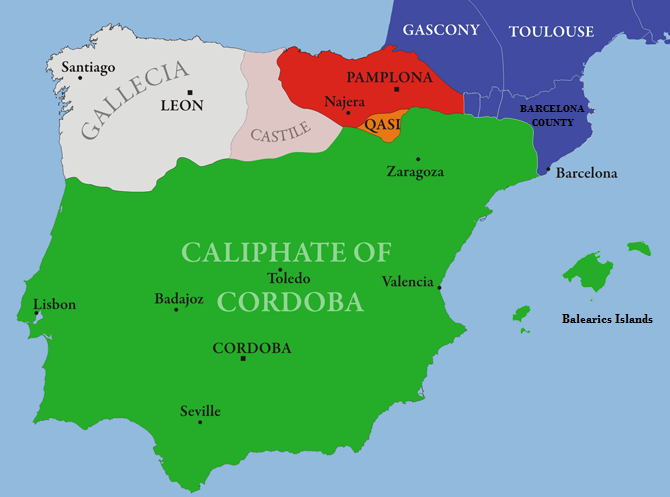
The palace was build by the Arabs in the IX century: in fact, as you know, since the VIII century to 1492, when the last Muslim bastion, Granada, fell,  the Arabs held a part of the Iberian Peninsula. In the beginning of the XI century, the Caliphate of Cordoba took up the biggest part of the Peninsula, as we can see in the picture,

The Iberic Peninsula in A.D. 1000
then the Christian kings of Iberian Peninsula managed, with the so-called Reconquista (which is the Spanish for "reconquest"), to conquer more and more lands belonging to the Arabs and at last the Arabs lost all their kingdoms in the Peninsula.

The "Reconquista" will end in 1492, with the fall of Granada, but already in the XII century the part of Iberian Peninsula which was controlled by the Arabs had significantly reduced
Zaragoza, too, was reconquered and after its reconquest the Aljaferia Palace was the residence of the king of Aragon and of his court and it still was in 1413, which is the year in which our story is set. In fact, Leonora, who is the Queen's companion, lives here and so does the Count of Luna, who backs the king the war against the Count of Urgell.

Inside the palace...
Well, in the beginning of the The duel, which is the name of the first act of Il Trovatore, the curtain opens on the entrance hall of the palace...

The entrance hall of Aljaferia Palace
...where Ferrando, which is the chief of the King's guard, tries to keep his soldiers awake (it is late night) by telling them the story of something happened a long long time ago...


What story is telling Ferrando? Well, he tells the story you already know, the story of Azucena's mother we talked about here. What is interesting is that he tells the story from his point of view, so, in his opinion, Azucena's mother was really a witch and Azucena's revenge was something cruel (well, we can agree at least with that). We'll see that later the same story will be retold by Azucena and, as you can imagine, her point of view will be completely opposite from Ferrando's one. Ferrando says also two things that we have to remember if we want to understand what will follow in the opera: he says that:

1) the father of the Count of Luna had the feeling that his son was not dead (as we know, he was right) and he made his son promise that he would have kept on looking for him
2) despite the many years which have passed, he could recognize Azucena and he would like to, because thus he would help the Count of Luna to have his revenge on the woman that killed his brother

But let's leave Ferrando and his soldiers to their story...

"Di due figli vivea padre beato/Il buon Conte di Luna..."
Part 1: The duel - A trobadour in the garden

...and let's move to the gardens of the Palace, where Leonora waits for the mysterious man that comes every night and sings for her. She says she had known him before the beginning of the war in a tournament, but then she didn't see him for a long time.

The garden of the Aljaferia Palace
The mysterious man comes and sings his song to Leonora...


...but he does not know that someone is spying him: it's the Count of Luna, who is in love with Leonora and does not want the mysterious trobadour to take her away. Leonora enters in the garden and she wants to hug her mysterious lover but in the darkness she walks into the Count and embraces him. Suddenly, the mysterious man comes out of the shadow, angry for her mistake and accusing her of being infaithful and the Count recognize him: he's Manrico, one of his enemies in the war!

Di geloso amor sprezzato/arde in me tremendo il foco!/Il tuo sangue, o sciagurato,/ ad estinguerlo fia poco!
Leonora says to Manrico: "Well, my love, it was dark and I thought that you were him, there's no need to be so angry! Do you really think I could love the Count?", while the Count wants to kill Manrico because they love the same woman (which is not a great reason, I admit, otherwise the mortality rates in high school would be approximately near to 80%, but, well, you know, this is an opera and in operas characters always want to kill someone). The Count and Manrico exeunt to fight a duel and Leonora faints.

You can see the complete scene here:

Then the curtain falls, the first part of the opera ends and so does our second episode of "A night at the opera". But don't worry: we'll be back soon for our third episode and we'll talk about the second part of this opera: La gitana, "The gipsy woman".

See you soon!

domenica 15 marzo 2015

A night at the opera: discovering "Il Trovatore" by Giuseppe Verdi - Episode 1 - A bad mistake: the story so far and the characters of the opera

Good evening ladies and gentlement and let me invite you at the theatre tonight in order to see one of the most beautiful Verdi's operas: Il Trovatore. Here's your favourite bass player speaking and we're ready for the first episode of...

1. Let's know more about "Il Trovatore"

Il Trovatore was first represented in 1853 and, together with Rigoletto and La Traviata, is part of Verdi's Trilogia popolare (Popular trilogy), which is called in this way because the three operas were and still are today loved very much by the audience. It was first represented in Rome and had immediately a huge success. We can understand why: the opera features some of the most beautiful arias and melodies in Verdi's career and it probably is one of the peaks of Verdi's production as a composer.

But Il Trovatore, though very successful among the audiences of all the world, has always been infamous among lots of people above all for its plot, which is really complex, and because it is an opera which is different from its fellows in the Popular Trilogy, being La Traviata and Rigoletto two operas in which we can find a deep look on social issues and a deep psychological analysis on characters, while in Il Trovatore characters have no psychological development during the opera and can appear sometimes a bit stereotyped.

So, is Il Trovatore really "a stupid opera with wonderful music"? I think it isn't and I'll try to show you why.

2. Historical setting

Il Trovatore, whose libretto was written by Salvatore Cammarano (who died before the end of the composition of the opera) from a play by Spanish writer Antonio Garcia Gutierrez, is set in Spain during the XV Century. In particular, the opera shows a specific moment in the history of Spain which is known as the revolt of the Count of Urgell.

In 1412, after the death of king of Aragon Martin I, many noblemen asked to get the crown. The reason was easy: as it often happened in Middle Ages, the king had died without leaving any heir. So, no royal babies in this story, I'm sorry. Well, between all the noblemen who wanted to be king there was the Count of Urgell, who really wanted the crown, but unfortunately didn't manage to get it.

In fact, in the same year, some representatives of kingdoms of Aragon and Valencia and of the Principality of Catalonia met and decided to give the crown to Fernando I of Aragon. This was called the Compromise of Caspe, from the name of the city in which the meeting took place, and, as you can imagine, the Count of Urgell didn't like this result. So, in 1413 he made a revolt against Fernando. He lost and went to prison, but this is not so important, because our story is set exactly during the few months of Urgell's revolt.

What you need to remember out of all those historical stuffs is that the two main male characters of the opera, Manrico and the Count of Luna, are on the opposite sides in this war: Manrico is part of Urgell's army, while the Count of Luna is allied with Fernando.

3. The characters

The main characters, in this opera, are four, two male characters and two female characters. Let's see who they are:

1) Manrico: he is an officer in the army of the Prince of Urgell. This work gives him a lot of free time, so he spends it in singing under the windows of Leonora, the woman he loves. That's why he's called "il Trovatore", "the Trobadour": the trobadour was a musician who, in Middle Ages, sung and entertained the nobles of the court; trobadours often pretended to be in love with the Lady of the Castle and composed songs and poems in her honour. As we can see, Manrico does not exactly do all this: he simply goes under Leonora's window and play for her, but he composes love songs for her, so probably this is the reason why Verdi and Cammarano call him a trobadour while he clearly isn't.


Manrico has humble origins: he believes to be the son of a gipsy woman, Azucena (even though in the end of the opera we'll know he isn't), and is not a nobleman, while his rival, the Count of Luna, is part of the traditional nobility of Spain. So, Manrico is an outsider, as Rigoletto is in Rigoletto and Violetta in La traviata.

2) The Count of Luna: he's a nobleman, he is a rival to Manrico for the love of Leonora and he is allied with Fernando of Aragon, so he and Manrico are enemies also on the battlefield.


You can see him in the picture, he does not seem a nice guy, does he?

3) Leonora: she is a companion to the Queen of Aragon and so she lives in Saragozza together with the Court of Aragon and the Count of Luna in the Aljaferia Palace. Manrico and the Count love her, she loves only Manrico and we can imagine that this will create some small problems during the opera.


4) Azucena: she is a gipsy woman and she's Manrico's mother or at least that's what we all believe...


4. What happened before: the prequel

There are some operas whose stories need some explanation to be understood. Il Trovatore is not one of them: some explanations wouldn't be enough to understand Il Trovatore's story, what would be really useful would be a prequel, better if it was a Star-Wars-like three-movies prequel. If Mr.George Lucas ever reads this blog, well, I'll ask him to think about it.

So, what's the problem with Il Trovatore's plot? The problem is that a part of the story is not shown on scene and what we know about it is what the characters on scene say about this old story. And this part of the story is not something really unimportant that you can ignore without problems, no, it is something which is very important to know in order to understand what happens on scene. So, you have no excuse: you have to know all about the dark past of Azucena, otherwise many parts of the plot will be quite incomprehensible.

Let's take a look at what happened before. It is nothing difficult, don't worry, just imagine this as one of those Star Wars opening crawls which explain you the story so far and everything will be OK...


A long, long time ago, in a galaxy far faraway called Spain, lived a Count which was called the Count of Luna. Wow, you'll say, we already know him! He is the angry guy with big moustache we've seen some minutes ago!

No, I'm sorry, this Count of Luna is not him. It's his father: in the times we're talking about the angry moustache guy is a young happy non-moustache boy and we won't care very much about him.

Well, the Count of Luna (the father to the moustache guy) has two sons: one is the moustache-man-to-be, the other is a little baby who sleeps all day in his cradle. Everyone is happy but one day the nurse of the little baby finds a gipsy woman sitting next to the cradle of the Count of Luna's son. This gipsy woman is Azucena's mother and, since the baby falls ill after her visit to his cradle, she is accused to be a witch and burnt at stake.

Azucena wants revenge for her mother's death: so, she abducts the Count of Luna's little baby and she wants to burn him but she makes a little mistake and burns her own son instead of the Count of Luna's one. Ooops... this is embarassing, isn't it? And you surely want to know why she does such a terrible mistake: well, the real answer is that there is no answer, which means that nowhere in the libretto Azucena explains how she could confuse two babies and kill the wrong one.

You can choose the explanation you like most...

1) Azucena was short sighted
2) The babies were identical
3) Add here your own explanation

...but the fact is that Azucena's son is dead and the Count's son isn't and he grows up among the gypsies thinking that Azucena is his mother. After some years, that son of the Count of Luna Azucena did not kill has become an officier in the army of the Count of Urgell and he's in love with a woman called Leonora.

Can you guess who he is? Of course, he is Manrico and he's completely unaware of the fact that the Count of Luna he hates (the man with big moustache, son to the Count of Luna who killed Azucena's mother) is actually his brother. The Count of Luna ignores it too and wants to kill Manrico.

This is what happened before the curtain opens to show us the story we'll talk about in our next post about Il Trovatore, in the second episode of A night at the opera.

See you soon!
lunedì 23 febbraio 2015

"La vera storia ci narra di Garzìa...": la dimensione narrativa del "Trovatore" e "La vera storia" di Luciano Berio

Dalle gravi
palpebre il sonno a discacciar, la vera
storia ci narra di Garzìa
germano del nostro Conte

Il Trovatore, Il duello

1. "Il capolavoro del tempo rivissuto": ciò che manca nel "Trovatore"

Il Trovatore è sempre stata un'opera che ha suscitato reazioni forti: amata per la sua splendida musica o odiata per la sua storia poco lineare e per il suo guardare nostalgico al passato dell'opera donizettiana. Quasi un corpo estraneo nel contesto della rivoluzione anche narrativa che Verdi stava iniziando a portare in scena con gli altri due capolavori della "Trilogia popolare", La Traviata e Rigoletto.

Eppure, se andiamo a scavare nel Trovatore, la seconda delle tre opere della "Trilogia", osserviamo che in realtà i punti di contatto con La Traviata e Rigoletto ci sono. In primo luogo, Manrico, come Violetta e Rigoletto, è un outsider. Non è nobile - è figlio di una gitana- mentre il Conte di Luna appartiene alla nobiltà tradizionale. Non solo: come in Rigoletto, anche nel Trovatore c'è un "evento centrale" che, dall'inizio alla fine dell'opera, condiziona le azioni dei personaggi: là si tratta della maledizione di Monterone, che torna continuamente (anche musicalmente, con i suoi Do ribattuti) nei pensieri di Rigoletto, qui della morte della madre di Azucena e della sua conseguente vendetta.

Ma quello che è il principale punto di interesse del Trovatore è il modo in cui viene raccontata la vicenda. Il trovatore è un'opera in cui c'è un vuoto enorme, negli eventi che vengono presentati in scena; infatti, come abbiamo avuto modo di vedere, non viene presentato sul palco l'evento principale, quello che condiziona tutti i personaggi: noi non abbiamo modo di vedere con i nostri occhi cosa è successo realmente alla madre di Azucena, non possiamo vedere la vendetta di quest'ultima e il tragico errore nell'uccidere suo figlio invece del figlio del Conte di Luna. Quello che sappiamo lo sappiamo perché ce lo racconta un personaggio sulla scena, ma quel personaggio ci presenta le vicende secondo la sua ottica deformante: Ferrando crede che la madre di Azucena fosse realmente una strega, Azucena, con un'omissione quasi freudiana, tralascia di dire che Manrico è il figlio del Conte di Luna che per sbaglio non uccise.

Quindi, quello che manca sulla scena è la vera storia di ciò che è accaduto in quel passato nebuloso, una vera storia che apprendiamo in modo polifonico da diversi personaggi che la raccontano secondo il loro punto di vista e di fatto il mosaico si compone soltanto alla fine dell'opera, quando Azucena dice al Conte di Luna che Manrico era suo fratello.

Quindi, come dice Girardi, Il Trovatore è "il capolavoro del tempo rivissuto", dove tutto converge su quell'evento lontano che scopriamo a poco a poco e che è il vero fulcro della vicenda.

2. "La vera storia": Berio, Calvino e "Il trovatore"

Di fatto, la lettura fatta sopra non è niente di particolarmente originale: è la lettura che dell'opera fanno Berio e Calvino quando, alla fine degli anni Settanta, scrivono La vera storia, una rivisitazione del Trovatore, vedendolo proprio come opera della memoria e del racconto.

L'opera è infatti divisa in due parti: nella prima, vengono finalmente presentati sulla scena gli avvenimenti che nel Trovatore sono solo raccontati. Vediamo dunque che un uomo (che è l'equivalente della madre di Azucena) viene condannato a morte e fucilato per ordine di Ugo, il Comandante della città (corrispettivo del padre del Conte di Luna), mentre Ada, figlia del fucilato, minaccia di rapire il figlio di Ugo per vendetta.

A questo si sovrappongono le vicende di Luca (che sarebbe Manrico) e Ivo (il Conte di Luna), che amano la stessa donna, Leonora (il nome originale, in questo caso, è mantenuto) e combattono per essa senza sapere di essere fratelli.

La seconda parte è invece più strana e meno lineare: infatti, vengono ripresi e rielaborati dei materiali musicali provenienti dalla prima parte e questo ha uno scopo ben preciso. Infatti, come scrive Berio

[...] nella Parte II viene dunque proposta una trasfigurazione e, per certi aspetti, un’analisi di quel paradigma di conflitti elementari [presentato nella prima parte], in una prospettiva musicale e drammaturgica sostanzialmente diversa.

(da La vera storia, nota dell'autore)

Quindi, in pratica, è come se nella seconda parte la storia raccontata nella prima parte venisse ri-raccontata in modo diverso. Vi ricorda qualcosa? Esatto, è precisamente quello che succede nei due racconti che, nel Trovatore, ricostruiscono l'antefatto della vicenda. Ferrando e Azucena raccontano la stessa storia, ma la raccontano in modo diverso, quasi opposto. Quelli che sono personaggi positivi nel racconto di Ferrando diventano assassini crudeli in quello di Azucena e viceversa e si crea dunque in questo modo la stessa divergenza nel modo di presentare la medesima storia che si ha nell'opera di Berio tra la prima e la seconda parte.

Berio riprende quindi la "polifonia narrativa" dei due racconti del Trovatore e la mette in scena presentando le stesse vicende due volte con modalità drammaturgiche diverse, come se due voci diverse stessero raccontando la stessa storia, la stessa vera storia.

E, come nel Trovatore siamo portati a chiederci quale sia la verità in quello che dicono Ferrando e Azucena, quale, tra le loro storie, sia la vera storia, così anche Berio ci porta a chiederci dove sia la verità in quello che vediamo sulla scena. Ma egli non ha risposte:

Ma dov’è dunque la vera storia: nella prima o nella seconda parte? Non lo so.

(ibidem)

E' interessante leggere Il trovatore alla luce della lettura che ne fa Berio, in quanto ciò permette di vederne la modernità al di sotto dell'apparente polvere belcantista. Il trovatore è opera del dubbio, è un'opera in cui nessun personaggio dice fino in fondo la verità al pubblico, che dunque deve modificare continuamente l'idea mentale che si è fatta degli eventi che hanno preceduto le vicende presentate sulla scena.

E' un'opera sulla narrazione e sulla sua capacità di inganno.

***
Per approfondire:

Per maggiori informazioni su La vera storia di Luciano Berio:
  • Qui trovate la nota dell'autore sull'opera
  • Qui trovate una lettura critica di Michele Girardi che ne mette in luce il rapporto di affinità con "Il Trovatore"

Per una lettura critica de Il Trovatore di Giuseppe Verdi:

  • Qui Fabrizio della Seta analizza il ruolo della dimensione favolistica e del racconto orale nel Trovatore