Visualizzazione post con etichetta Il duello. Mostra tutti i post

giovedì 19 marzo 2015

A night at the opera: discovering "Il Trovatore" by Giuseppe Verdi - Episode 2 - The first part: the duel

Hello and welcome back to A night at the Opera, the programme which explains you opera with images and words. In our latest episode, we spoke about the historical setting, the characters of Il Trovatore and about the never-seen-on-scene Azucena's mother's story which is, as you will know soon, fundamental to understand what happens in the opera.

Well, now let the opera begin and the curtain open: ladies and gentlemen, here's Il Trovatore by Giuseppe Verdi.

Part 1: The duel - Ferrando's tale

When the curtain opens, we're in the Aljaferia Palace in Zaragoza. Which is a very beautiful place, as you can see in the pictures below:

The Aljaferia Palace by day and by night

The palace was build by the Arabs in the IX century: in fact, as you know, since the VIII century to 1492, when the last Muslim bastion, Granada, fell,  the Arabs held a part of the Iberian Peninsula. In the beginning of the XI century, the Caliphate of Cordoba took up the biggest part of the Peninsula, as we can see in the picture,
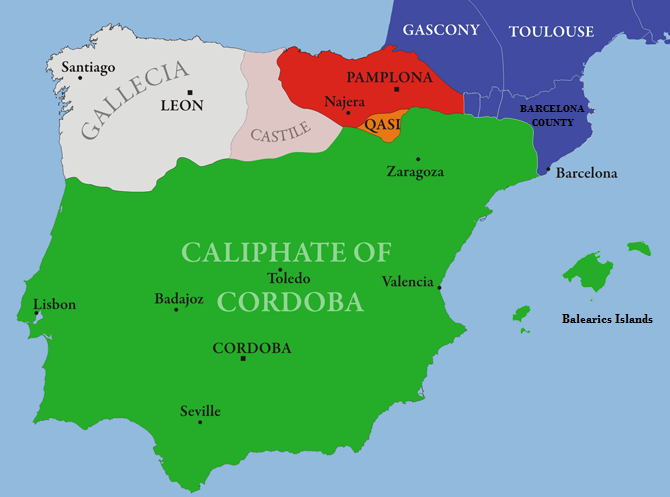
The Iberic Peninsula in A.D. 1000
then the Christian kings of Iberian Peninsula managed, with the so-called Reconquista (which is the Spanish for "reconquest"), to conquer more and more lands belonging to the Arabs and at last the Arabs lost all their kingdoms in the Peninsula.

The "Reconquista" will end in 1492, with the fall of Granada, but already in the XII century the part of Iberian Peninsula which was controlled by the Arabs had significantly reduced
Zaragoza, too, was reconquered and after its reconquest the Aljaferia Palace was the residence of the king of Aragon and of his court and it still was in 1413, which is the year in which our story is set. In fact, Leonora, who is the Queen's companion, lives here and so does the Count of Luna, who backs the king the war against the Count of Urgell.

Inside the palace...
Well, in the beginning of the The duel, which is the name of the first act of Il Trovatore, the curtain opens on the entrance hall of the palace...

The entrance hall of Aljaferia Palace
...where Ferrando, which is the chief of the King's guard, tries to keep his soldiers awake (it is late night) by telling them the story of something happened a long long time ago...


What story is telling Ferrando? Well, he tells the story you already know, the story of Azucena's mother we talked about here. What is interesting is that he tells the story from his point of view, so, in his opinion, Azucena's mother was really a witch and Azucena's revenge was something cruel (well, we can agree at least with that). We'll see that later the same story will be retold by Azucena and, as you can imagine, her point of view will be completely opposite from Ferrando's one. Ferrando says also two things that we have to remember if we want to understand what will follow in the opera: he says that:

1) the father of the Count of Luna had the feeling that his son was not dead (as we know, he was right) and he made his son promise that he would have kept on looking for him
2) despite the many years which have passed, he could recognize Azucena and he would like to, because thus he would help the Count of Luna to have his revenge on the woman that killed his brother

But let's leave Ferrando and his soldiers to their story...

"Di due figli vivea padre beato/Il buon Conte di Luna..."
Part 1: The duel - A trobadour in the garden

...and let's move to the gardens of the Palace, where Leonora waits for the mysterious man that comes every night and sings for her. She says she had known him before the beginning of the war in a tournament, but then she didn't see him for a long time.

The garden of the Aljaferia Palace
The mysterious man comes and sings his song to Leonora...


...but he does not know that someone is spying him: it's the Count of Luna, who is in love with Leonora and does not want the mysterious trobadour to take her away. Leonora enters in the garden and she wants to hug her mysterious lover but in the darkness she walks into the Count and embraces him. Suddenly, the mysterious man comes out of the shadow, angry for her mistake and accusing her of being infaithful and the Count recognize him: he's Manrico, one of his enemies in the war!

Di geloso amor sprezzato/arde in me tremendo il foco!/Il tuo sangue, o sciagurato,/ ad estinguerlo fia poco!
Leonora says to Manrico: "Well, my love, it was dark and I thought that you were him, there's no need to be so angry! Do you really think I could love the Count?", while the Count wants to kill Manrico because they love the same woman (which is not a great reason, I admit, otherwise the mortality rates in high school would be approximately near to 80%, but, well, you know, this is an opera and in operas characters always want to kill someone). The Count and Manrico exeunt to fight a duel and Leonora faints.

You can see the complete scene here:

Then the curtain falls, the first part of the opera ends and so does our second episode of "A night at the opera". But don't worry: we'll be back soon for our third episode and we'll talk about the second part of this opera: La gitana, "The gipsy woman".

See you soon!

martedì 10 febbraio 2015

Opera made simple: scopriamo "Il Trovatore"... - Parte seconda: Il duello

Cominciamo ora a entrare nel vivo dell'opera affrontando la prima parte del Trovatore. Un po' bizzarramente, in quest'opera, invece della consueta divisione in atti, troviamo una divisione in quattro parti ciascuna dotata di un proprio titolo.

Le parti in questione sono:
  1. Il duello
  2. La gitana
  3. Il figlio della zingara
  4. Il supplizio
...e quindi, appena si alza il sipario, inizia la prima parte, Il duello.

1. Il duello: il setting e il contesto storico

All'inizio dell'opera, ci troviamo a Saragozza, nel palazzo dell'Aljafería. Cioè siamo nel palazzo che potete vedere qui sotto,

Il palazzo dell'Aljafería by day and by night

che fu costruito dagli Arabi nel IX secolo e poi, dopo la riconquista di Saragozza da parte dei cristiani, usato come sede da parte dei re di Aragona. Ed è proprio per il re di Aragona che parteggia il Conte di Luna, un nobiluomo aragonese che impareremo a conoscere bene nel corso della vicenda, mentre Leonora, la donna amata dal Conte, è la dama di compagnia della Regina di Aragona.

Gli interni del Palazzo dell'Aljafería

E Manrico? No, Manrico non parteggia per il re di Aragona, ma per capire questo aspetto dobbiamo immergerci un attimo nella storia spagnola.

Il giardino interno del Palazzo dell'Aljafería
Nel 1412, il conte di Urgel aveva provato a presentare la propria candidatura alla corona di Aragona, visto che il re Martino I "l'Umano" era morto senza lasciare eredi. Non ce l'aveva fatta, dal momento che i rappresentanti dei regni di Aragona e di Valencia e del principato di Catalogna, dopo aver valutato i vari candidati, avevano nominato re, con il cosiddetto Compromesso di Caspe, Fernando I d'Aragona.

Il nostro Urgel non l'aveva presa bene e nel 1413 aveva preso le armi contro il re Fernando I. Non gli andò granché bene, visto che la rivolta fu soffocata nel giro di pochi mesi e lui fu condannato alla prigione perpetua, in ogni caso, Il trovatore è ambientato nei pochi mesi della rivolta del conte Urgel e i due personaggi  principali dell'opera, manco a dirlo, si trovano su fronti opposti:

1) Manrico è un ufficiale dell'esercito del conte Urgel
2) Il Conte di Luna, come già detto, parteggia invece per il re Fernando I d'Aragona

I due si conoscono - lo apprendiamo nella prima parte dell'opera - già da prima dell'inizio delle vicende presentate in scena e non si trovano simpatici.

A questo punto, possiamo far alzare il sipario: abbiamo tutto quello che è necessario per capire la prima parte dell'opera...

2. Il duello: il racconto di Ferrando

Appena il sipario si alza, siamo in presenza di una allegra scena di svacco generale: è notte, siamo nell'atrio del Palazzo dell'Aljafería (cioè nel luogo che possiamo vedere nell'immagine qui sotto)


e l'atmosfera è un po' da "rompete le righe": ci sono un po' di soldati stravaccati a destra, un po' di soldati stravaccati a sinistra e Ferrando, che è il capo delle guardie del Conte di Luna e verosimilmente non vuole prendersi un cazziatone per l'atmosfera "flower power" che si è venuta a creare, cerca di richiamare tutti all'ordine.

I soldati gli danno retta, però, per stare svegli, gli chiedono di raccontare loro la storia di García, il fratello del Conte di Luna che molto tempo prima è stato rapito e ucciso. Ferrando lo fa e gli racconta la storia che già sappiamo, cioè che la madre di Azucena è stata uccisa per stregoneria e Azucena, per vendetta, ha rapito e bruciato il figlio del Conte di Luna. Ferrando aggiunge inoltre che gli piacerebbe ritrovare Azucena per poterla uccidere.

"Di due figli vivea padre beato/Il buon Conte di Luna..."

Tutte cose che già sappiamo, insomma. Quello cui vi prego di prestare attenzione sono le parole con cui i soldati chiedono a Ferrando di raccontare loro la storia. Essi dicono:

Dalle gravi palpebre
il sonno a discacciar, 
la vera storia ci narra di Garzia, 
germano al nostro Conte

Vedremo che, quando Berio, nella seconda metà del Novecento, scriverà un'opera riprendendo in parte Il trovatore, la chiamerà appunto La vera storia, richiamando così la dimensione narrativa che attraversa l'intero Trovatore.

Comunque, qui sotto potete sentire questo primo frammento dell'opera:


3. Il duello: Leonora, Manrico e il Conte di Luna

I giardini del Palazzo dell'Aljafería, dove si svolge la seconda parte del primo atto
Dopo che Ferrando ci ha raccontato l'antefatto, l'azione si sposta nei giardini del Palazzo, dove Leonora aspetta il Trovatore, che poi è Manrico. L'ha conosciuto prima che la guerra civile cominciasse durante un torneo, poi l'ha perso di vista durante la guerra ma ecco che da qualche sera egli è ricomparso con il suo liuto a farle la serenata sotto casa.


Quello che Leonora non sa è che quella sera ad aspettare il Trovatore c'è anche il Conte di Luna, che sa della storia del Trovatore che va a fare la serenata a Leonora ed è geloso, visto che anche lui ama Leonora. Quindi, quando il Trovatore arriva e le fa la serenata, Leonora scende e si butta tra le braccia del primo che trova pensando che si tratti di Manrico. E invece no: scopre con sommo rammarico che ha dichiarato il suo amore alla persona sbagliata, cioè al Conte di Luna.

Questo giochino dello scambio di persona è abbastanza frequente in Verdi (che lo usa anche, per dire, nel Don Carlos) e in effetti funziona per movimentare la trama, perché immediatamente Manrico entra in scena accusando Leonora di tradimento, Leonora replica che "Oh, caro, ma io pensavo che fossi tu"

LEONORA:
Qual voce!... Ah, dalle tenebre 
tratta in errore io fui! 
(riconosce entrambi e gettasi ai piè di Manrico; agitatissima) 
A te credei rivolgere
l'accento e non a lui... 
A te, che l'alma mia
sol chiede, sol desia... 
Io t'amo, il giuro, io t'amo
d'immenso, eterno amor! 

e il Conte di Luna si incazza come una biscia perché già si deve sopportare Manrico come nemico in battaglia, ci mancava solo che dovesse contendere con lui per la stessa donna.

Di geloso amor sprezzato/arde in me tremendo il foco!/Il tuo sangue, o sciagurato,/ ad estinguerlo fia poco!

Comunque sia, la scena si conclude con Manrico e il Conte che si allontanano con le spade sguainate per duellare e con Leonora che, tanto per darsi un'aria e non rimanere lì come una pera cotta, sviene come nella migliore tradizione dell'Opera italiana.


A questo punto il sipario si chiude e io vi do appuntamento alla prossima puntata per la seconda parte dell'opera, La Gitana.

P.S.: se siete interessati al libretto completo del Trovatore potete trovarlo qui oppure qui.